
Indoor Plant Care in an Air-Conditioned Home in Dubai
Why your indoor plants keep dying in a Dubai apartment or villa, and the small adjustments that actually keep them alive through AC season.
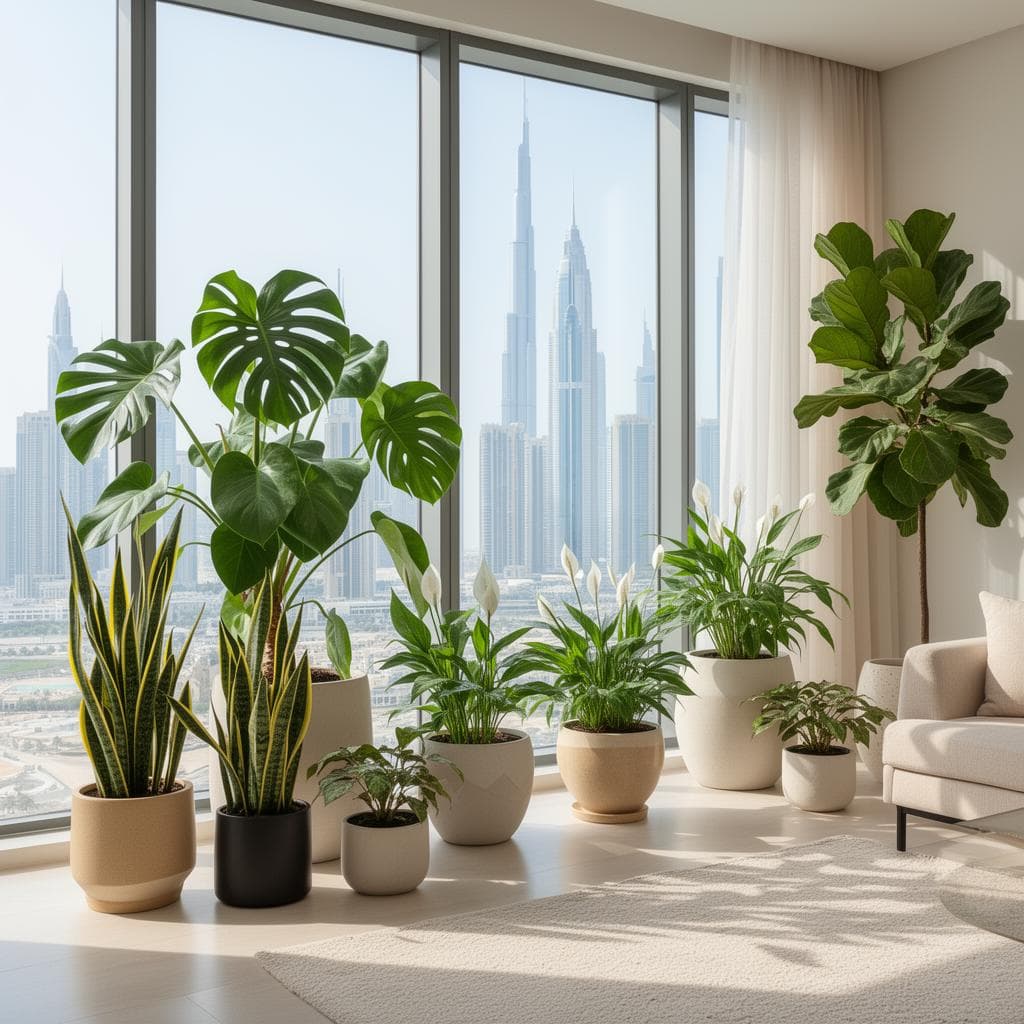
Most people in Dubai assume the air conditioning is what kills their indoor plants. It isn't, at least not directly. A home held at 22 to 24 degrees from May to October is well within the comfort zone of almost every common houseplant. The real problems are quieter and easier to miss: the air inside an AC'd home sits at roughly 30 to 40 percent humidity for months on end, cold air blows straight onto leaves from ceiling vents, and the watering rhythm people use is borrowed from outdoor plants or from cooler climates where pots actually dry out at a sensible pace.
Add to that the light situation. Tinted villa and apartment glass cuts a surprising amount of usable light, and a windowsill that looks bright to you is often low-light to a plant. Meanwhile the same west-facing window that feels dim in the morning can hit 45 degrees or more at the leaf surface by late afternoon, which scorches leaves even through the tint.
Once you understand that the killers are humidity, drafts, light loss and overwatering rather than the AC temperature itself, indoor plant care in Dubai gets a lot simpler. Below is what actually works in a typical apartment or villa here.
Raising humidity without relying on misting
Misting is the advice everyone gives and the one that does the least. A few sprays of water evaporate from leaves within minutes and barely shift the humidity around the plant. What does work is changing the environment.
Group plants together. Three or four pots clustered on a tray will create a small humid pocket around themselves through their own transpiration. Add a pebble tray underneath, filled with water that sits below the top of the pebbles so the pots are not actually standing in water, and that pocket holds longer. A small room humidifier in the corner where your plants live makes a bigger difference than any amount of misting and is worth it if you keep humidity-sensitive species like calathea or peace lily.
Keep plants out of the direct path of vents. Cold dry air blowing onto a leaf for hours is what causes the crispy brown edges people blame on the AC in general. Move the plant a metre to the side and the problem usually stops.
Placement: drafts, west windows and the tinted-glass problem
Light in a Dubai home is almost never what it looks like. Bronze or grey tinted glass can cut photosynthetically useful light by half or more, so a spot that looks bright to your eye may only support a snake plant or ZZ, not a fiddle-leaf fig.
A few placement rules that hold up in most homes here:
- Keep plants at least a metre away from any AC vent or split-unit airflow path.
- East-facing windows are the best all-round indoor position: gentle morning light, no afternoon scorch.
- West and south-facing windows need a sheer curtain between May and October, or the plant moved back a metre, even with tinted glass.
- Inner-room corners that look bright to you are usually too dark for anything except snake plant, ZZ, pothos and some dracaena.
- If you are not sure, put your hand where the plant sits at midday. If your hand casts a sharp-edged shadow, it is bright enough for most species. A soft fuzzy shadow means low light.
Watering rhythm in an AC'd home
This is where most plants die. Cool dry indoor air slows transpiration, so a pot that would dry out in three days on a shaded balcony might take eight to ten days indoors. People keep watering on the old schedule and the roots rot.
The rule is to check, not to schedule. Push a finger two knuckles into the soil. If it comes out with soil sticking to it, wait. If it comes out clean and dry, water thoroughly until it runs out of the drainage holes, then empty the saucer. Most indoor plants in Dubai homes want this every seven to fourteen days in summer, not every two or three.
Feed lightly during the growing months from roughly March to October, and barely at all in the cooler months when growth slows. If you want a structured approach, our plant fertilising service covers what to use and how often for the common indoor species.
Best-performing species for an air-conditioned home
If you are starting over or replacing plants that keep dying, stick to species that genuinely tolerate dry indoor air:
- Snake plant (Sansevieria) - almost indestructible, handles low light and infrequent watering.
- ZZ plant - same tolerance profile, glossy leaves, very forgiving.
- Pothos - fast, trailing, happy in most positions away from direct vents.
- Monstera - good in bright indirect light, tolerates indoor humidity better than people expect.
- Rubber plant (Ficus elastica) - upright, dramatic, copes with AC well as long as light is decent.
- Philodendron - similar profile to pothos, lots of leaf shapes to choose from.
- Dracaena - tall, sculptural, fine in lower light.
- Areca palm - the most reliable indoor palm here, though it wants more light than most.
The ones that fight you indoors are calathea, most ferns, fiddle-leaf fig (very sensitive to drafts and position changes) and peace lily (drops dramatically the moment humidity gets low). They can work, but only if you commit to a humidifier and a draft-free spot. For a broader comparison see our guide to the best indoor plants for Dubai apartments, or browse what we currently have in the shop.
Salt deposits and the monthly hard-water flush
DEWA water is hard, and over months the salts build up in the soil as a white crust on the surface and around the rim of the pot. This burns roots and causes leaf-tip browning that looks identical to low humidity damage.
Once a month, take the pot to a sink or outside and water it with roughly double the normal volume in one go, letting it drain freely. This flushes the accumulated salts out through the drainage holes. If the crust on the soil surface is heavy, scrape off the top centimetre and top up with fresh potting mix.
If you can collect the condensate water that drips from your villa AC unit, use it. It is essentially distilled and is excellent for plants, especially humidity-sensitive species that react badly to mineral build-up. If salt damage is already advanced, the plant probably needs fresh soil entirely, which is what our repotting service is for.
Leaving plants over the summer holiday
Most households here travel for two to four weeks in July or August, and this is when a lot of indoor plants quietly die. A few things help.
Water deeply the morning you leave, until water runs freely from the drainage holes. Move every plant away from west and south windows into the middle of the room or against a north wall. Pull blinds halfway to cut light and slow transpiration further. Leave the AC running at a normal temperature rather than switching it off, because a closed-up apartment in August will cook plants faster than a cool one will dry them.
Self-watering globes and wicks help but are not reliable on their own past about ten days. If you are away longer, ask a neighbour to come in once at the midpoint and give everything a deep water. That single visit is worth more than any gadget.
If you would rather not think about any of this
Indoor plants in Dubai homes are not difficult once the routine is set, but the routine does need to actually happen every week. If you would rather have someone come in weekly or monthly to check moisture, flush salts, rotate plants and catch problems early, our plant-maintenance team handles exactly that across apartments and villas. It is usually the difference between plants that limp along and plants that look the way they did the day you bought them.
Frequently Asked Questions
Related services
Need help putting this into practice? Our team handles these services across Dubai, Abu Dhabi and Sharjah.