
How Often to Water a Garden in Dubai: A Practical Schedule
A straight answer on watering a Dubai villa garden through summer and winter, with timings, runtimes and the soil test that tells you when to stop.
Quick answer
In Dubai summer (May-September, 38-48°C), lawns need watering twice a day for 12-18 minutes per cycle, shrub beds once a day for 30-45 minutes, and trees or palms a long soak every two days. In winter (December-February), lawns drop to once a day or every other day for 8-12 minutes, and trees or palms need watering only every 4-7 days.
Key takeaways
- Summer (May-September): lawns need watering twice daily for 12-18 minutes per cycle.
- Summer: shrub beds need watering once a day for 30-45 minutes; trees and palms need a long soak every 2 days.
- Winter (December-February): lawns drop to once a day or every other day, for 8-12 minutes.
- Winter: trees and palms need watering only every 4-7 days.
- Water early morning (roughly 4-6 AM) or evening (5-7 PM), and never combine pop-up sprinklers and drip lines on the same valve.
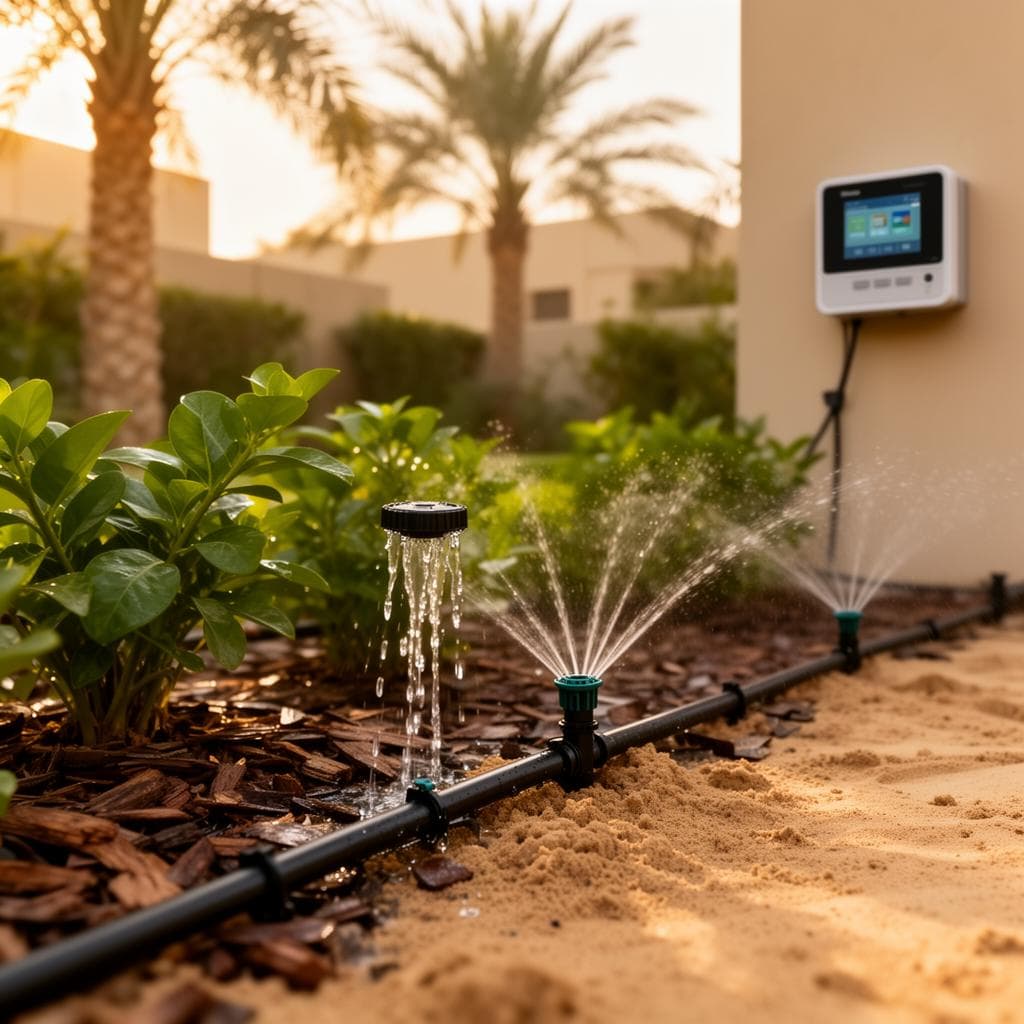
Most villa owners in Dubai ask the wrong question. They want to know how many times a day to switch the irrigation on, when the better question is how deeply the water is reaching and at what time of day it goes in. A lawn watered for two minutes at noon is worse off than a lawn watered for fifteen minutes at five in the morning, even if the first one ran three times.
Getting this right matters for two reasons. The first is plant health: shallow, frequent watering trains roots to sit near the surface where the soil is hottest, which is exactly where you do not want them in a 45°C July. The second is your DEWA bill. The slab tariff penalises heavy household water use, and an over-watered villa garden is one of the easiest ways to push yourself into the expensive band without noticing.
What follows is the schedule we actually use on the gardens we maintain, adjusted for the kind of mixed planting most Dubai villas have: a patch of lawn, some shrub beds, a few trees or palms, and a row of pots near the entrance.
Water at dawn or dusk, never in the middle of the day
The only two useful watering windows in Dubai are roughly 4 to 6 AM and 5 to 7 PM. Early morning is the best of the two because the soil is at its coolest, wind is usually low, and leaves have all day to dry off, which keeps fungal problems down. Evening is a workable backup, especially for lawns in peak summer that need a second cycle.
Midday watering does two things, both bad. The droplets that land on leaves act like small lenses and scorch the tissue underneath. The water that reaches the soil largely evaporates before the roots can use it, so you pay for water that never does any work. If your controller is set to run at 10 AM or 1 PM, change it tonight.
Depth beats frequency
The goal of any single watering cycle is to wet the soil to the depth where the roots live. For a lawn that is around 15 to 20 cm. For shrubs and hedges it is 30 cm. For trees and mature palms it is deeper still, 45 to 60 cm at the drip line.
The simplest field test is a long screwdriver or a thin metal rod. After a cycle finishes, push it into the soil in two or three spots. If it slides easily down to 15 to 20 cm in a lawn or bed, the cycle was long enough. If it stops at 5 cm, you watered the surface and nothing more. Adjust runtime up in small steps until the rod goes where you want it.
This is also the test that tells you to stop. If the screwdriver goes in like the soil is pudding, you are over-watering, and you will see it later as yellowing leaves, fungus gnats around pots, or a sour smell in the beds.
A summer schedule by plant type
From May to September, when daytime temperatures sit between 38 and 48°C, a typical villa garden in Dubai runs something like this:
- Lawn (pop-up sprinklers): twice a day, 12 to 18 minutes per cycle. One cycle around 5 AM, one around 6 PM. Adjust by zone, so sunny zones get the longer end of that range and shaded zones the shorter.
- Shrub beds and hedges (drip): once a day, 30 to 45 minutes, early morning. Drip is slow on purpose; the long runtime is what gets the water deep.
- Trees and palms (drip at the drip line): every two days, a long soak. Move the emitters out as the canopy grows, because watering the trunk does very little.
- Pots and containers: up to twice a day in peak summer. Terracotta dries fastest, then plastic, then glazed ceramic. Small pots in full sun may need a hand-water top-up even with drip.
- Established native trees (ghaf, sidr, neem): very little once they are settled in. A deep soak every week or two in summer is plenty.
A non-negotiable rule: never put pop-up sprinklers and drip lines on the same valve. Sprinklers deliver water in minutes; drip delivers it over half an hour or more. If they share a valve, one of them is always wrong. If your system is wired this way, a proper irrigation setup is the fix, not a longer runtime.
Winter is a different garden
From December to February, with cool nights down to 12 to 18°C, the same garden needs roughly half the water. A reasonable winter starting point is:
- Lawn: once a day or every other day, around 8 to 12 minutes.
- Beds: every other day, 20 to 30 minutes on drip.
- Trees and palms: once every four to seven days.
- Pots: once a day, sometimes less.
The screwdriver test still applies. Cool air slows evaporation, so water you put in stays in. Running the summer schedule through January is one of the most common ways gardens get root rot in spring.
Shoulder seasons (March, April, October, November) sit between the two. Move runtimes up or down a few minutes at a time and watch the soil, not the calendar.
The mistakes that cost the most
A few patterns turn up again and again on villa gardens we are called to rescue:
- The controller is set and forgotten. A schedule that worked in November is still running in July, or vice versa.
- Drip emitters are clogged with mineral build-up from Dubai's hard water, so a bed that looks watered on the controller is bone dry at the roots.
- Sprinkler heads are misaligned and water the wall or the pavement more than the lawn.
- The garden is watered every day for five minutes, training roots to stay shallow and then cooking them in the first heatwave.
- Nobody has ever pushed a screwdriver into the soil to check.
Most of these are ten-minute fixes once you know to look. If you want a broader seasonal view, our notes on preparing a Dubai garden for summer cover mulching, shade and pruning, which all reduce how much water the garden needs in the first place.
If you would rather not work it out yourself
If this all sounds like more attention than you want to give the controller, that is fair. We run a garden watering and irrigation tuning service where we audit the existing system, check valve grouping, clean and replace emitters, set seasonal schedules on the controller, and leave you with runtimes that match your actual plants and soil. It is usually the cheapest single change a Dubai villa can make to its garden, both for the plants and for the DEWA bill.
Related resources
- ServiceOur Garden Watering in Dubai
- GuideSmart Irrigation Systems in the UAE, 2026 Guide
- GuideIrrigation Systems for Dubai Villas: Drip, Sprinkler, and What Actually Works
- GuideWhy Your Plants Die in a Dubai Summer (And What to Actually Fix)
- TermDrip Irrigation
- TermSprinkler Zone
- Green BeetleRead customer reviews